The Wideboy: Phil Tufnell
What Now?
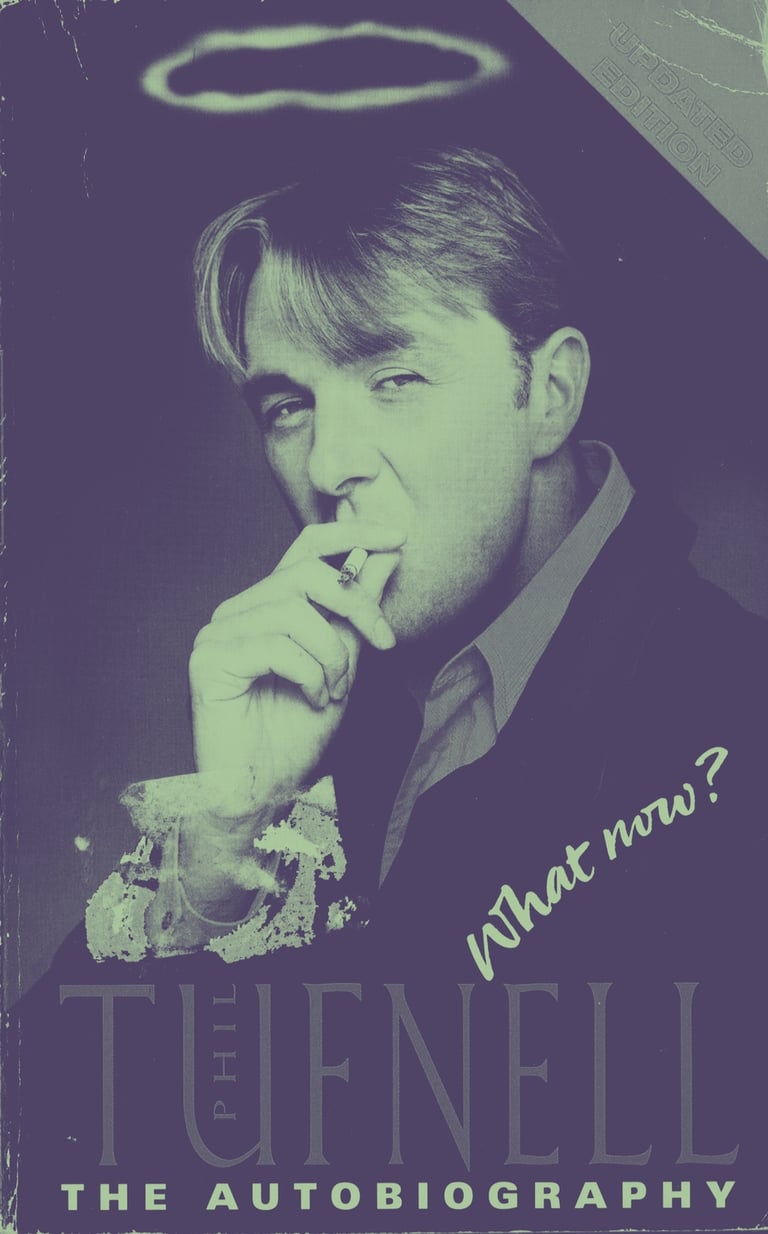
Phil Tufnell (2000) – What Now? London: CollinsWillow
The cover of What Now? takes you straight back to the late 90s, featuring a picture of its subject with hair in a floppy centre-parting, wearing a lurid green shirt and pretending to smoke a cigarette. If the edges of historic lad culture may have softened in the minds of some, then occasionally a reminder comes along that elements of it were quite dodgy and horrible, hitting you like the bitter taste of your first beer in a smoky pub.
‘Tuffers’ is now reincarnated as a genial, laid-back presence on the BBC’s Test Match Special, the enduring commercial appeal of his brand apparently sufficient to warrant the release of several further volumes of autobiography and autobiography-adjacent tales. What Now? is, though, the original, written with then Mail on Sunday cricket correspondent Peter Hayter, and clearly marketed as leaning into the more controversial elements of the cricketer’s off-field life.
Even though the Tufnell of the book’s text is much more sensible and contrite than the cover may suggest, some of the tales contained within make for fairly grim reading. If lurid green shirts, floppy centre-partings and cigarettes don’t force a swift memory check of what that time was really like, then repeated references to ‘lovelies’ and ‘birds’ certainly will. There is a sense that no embellishment was required here, and that some of the antics described were not as untypical of the era as the decision to reveal and revel in them.
On the cricket field, I first saw Tufnell bowl in 1993, toiling away fruitlessly in the Indian sun while his opposition counterparts had a field day bamboozling the entire English batting order.
At the time, my Dad made slightly cryptic comments that alluded to the left-armer’s apparently frequent indiscretions, but wisely decided that any further detail would be inappropriate for the ears (and mind) of his 11-year-old son, and I was left with only a vague notion that he was, for reasons unknown, adjudged to be of poor moral character.
Of more concern to me at the time was his lack of success with the ball, and once Tufnell was dropped after two further defeats at the outset of the 1993 Ashes, I fully expected it to be for good: reasoning, with my child’s brain, that because I’d seen someone play badly, they must be a bad player.(1)
Regardless of any self-inflicted turmoil incurred during the previous 12 months – the chapter describing 1992 is titled ‘Out of Control’ – Tufnell had also been subject to some poor man management. In India he was a victim of the selectors’ romantic obsession with the lost art of leg spin in the form of Ian Salisbury, who had missed out on selection for the tour but somehow leap-frogged both Tufnell and his Middlesex colleague John Emburey into the team for the first Test from outside the squad.
As Tufnell notes here, the fact that he was mainly only able to contribute with the ball was also held against him, as Salisbury was talked up as a competent tail-end batsman, good fielder, and the kind of bloke who didn’t get into much trouble on tour. But, as Salisbury and almost every other England cricketer of the 90s later found, there was nothing quite as good for your reputation as a spell out of the team, and public opinion soon switched back to a notion that you must ‘pick your best bowlers, regardless’.
And Tufnell probably was the best English spinner of the era. After overcoming a difficult series on his Ashes debut in 1990/1 – Tufnell alleges umpire Peter McConnell called him a ‘pommie c**t’ in response to an enquiry about how many balls were left in the over, while captain Gooch was unimpressed by his fielding and general attitude – he had bowled England to victory against the West Indies at home in 1991 and at Christchurch during the following winter series in New Zealand.
But he was in and out of the team, with no appearances between the 1994/5 Ashes — on which he had a brief mental breakdown before discharging himself from the hospital and apparently carrying on as if nothing had happened — and the tours to Zimbabwe and New Zealand in 1996/7, a period which coincided with Ray Illingworth’s time in sole charge of the team as coach and selector. In light of the turmoil in Tufnell’s personal life, Illingworth, a fan both of multi-dimensional cricketers and a rapid turnover in selection, was evidently keen to examine other options.
After a relatively fruitful spell bowling in tandem with Robert Croft in 1996/7, and then a final match-winning performance against Australia at The Oval, the good days became less frequent. Tufnell could be a wonderful bowler to watch, with an action that suggested craft and guile even if the batsmen were playing him with ease,(2) although he was also frequently criticised by commentators and pundits for retreating to defensive tactics – particularly bowling over the wicket to right-handers – too quickly.
It’s tempting to say that, as with many players from that 90s team, Tufnell could have benefited from more careful handling and management. The emergence and success of Shane Warne also meant that the preoccupation with finding an English leg-spinner never quite went away, even if it usually just meant recalling Salisbury for a match or two. However, as the decade drew to a close, Tufnell increasingly enjoyed backing as the number one spinner – except during Alec Stewart’s brief tenure – but too often struggled to make an impact.
The conclusion of What Now? – or this paperback edition, at least – sees Tufnell back in the cold again, after failing to convince new coach Duncan Fletcher, another fan of the multi-faceted cricketer, on the 1999/00 tour of South Africa. As the first round of central contracts are issued the following summer, the selectors turn away from Tufnell: not towards Ashley Giles, his eventual successor, but to Lancashire’s Chris Schofield, a young and unproven leg-spinner.
--
Young Lions Sometimes Roar: Watching Bad Cricket (And Playing Cricket Badly) in the 90s by Ben Richards is out now.
Notes:
(1) If I judge myself too harshly here, I just have to remind myself that all it takes these days is for a bowler to be hit for four and people immediately begin messaging the BBC live text to call for their removal from the team. Thanks for sending that in, Rob from High Wycombe — by the looks of things, it isn’t just you that thinks this, well done.
(2) For some reason, I always associate Tufnell with one of the phenomena that most confused me during my early cricket-watching career: the perennially optimistic wicketkeeper who, during a sound thrashing, continues to act as if each and every ball delivered by a spin-bowling teammate is about to take a wicket, despite mounting evidence to the contrary.
More Profiles
© Ben Richards 2026