The Fading Warhorse: Graham Gooch
Gooch: My Autobiography
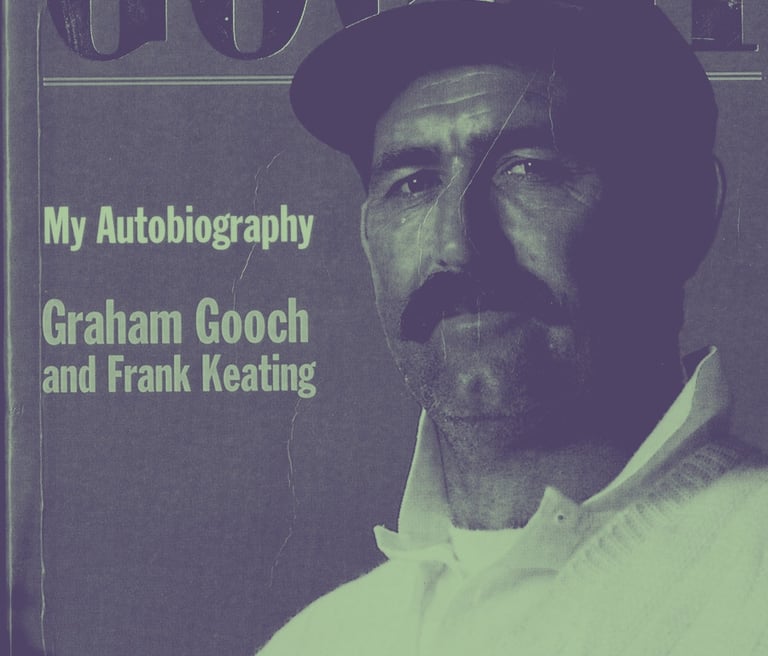
Graham Gooch and Frank Keating (1996) — Gooch: My Autobiography, London: CollinsWillow
When I first watched England on their ill-fated tour of India in 1993, Graham Gooch was the only player in the team that I’d heard of — and that was only because he’d lent his name to a computer game, Graham Gooch’s Test Cricket, on the Amstrad CPC some years earlier. Unsurprisingly, the game doesn’t earn a mention in this autobiography, co-authored with the late Frank Keating.
Gooch: My Autobiography wasn’t one of the books I owned back in the 90s: I’d already missed the high points of Gooch’s captaincy career and was only witness to the very end, by which point he seemed a slightly sad, defeated figure. Similarly, the hot issues of the early 90s, such as the tensions between Gooch and David Gower on the 1990/1 Ashes tour, or allegations of ball tampering by Pakistan during the bad-tempered home series in 1992, were slightly before my time.
Keating, allowing space for his own voice here in order to add some gushing praise of his co-author’s run-scoring achievements to what would be an otherwise rather understated account, writes in the introduction: ‘Stubbornness, cussedness, obstinacy, implacable self-confidence … these four resolute and unfancy qualities represent … Gooch not only fiercely defending his wicket, but counter-attacking with thunderous defiance for two decades’.
This was the player I knew by reputation back then: the number 1 batsman in the world who had taken an unusual route to the top, after a pair on debut in 1975 and some mixed fortunes throughout the 80s. Gooch rebuilt his form and career having been made captain at the conclusion of a home Ashes defeat in 1989, despite struggling so much with the bat that he was omitted from the team for the fifth Test at his own request, and with his age and average both hovering in the late 30s.
By the time of the India tour, he had become an English batting colossus, turning the team’s fortunes around while contributing big runs, making more Test hundreds in that time — including a triple century in 1990 — than he had previously managed across the rest of his career.
India, though, went badly: Gooch was dogged by public outrage over the non-selection of David Gower, missed one Test through illness, and made few runs in the others as England lost 3-0. Shortly afterwards, the Ashes were rather meekly surrendered at home, and he resigned as captain.
Perhaps it was because the team was losing, or down to his undemonstrative demeanour — which, as this book makes clear, was very much his general brand — but in remembering that 1993 series against Australia, I always overlooked the fact that his batting was still at this point in good working order. In fact, he was the top run-scorer on either side, and contributed two hundreds, standing firm while Shane Warne was wreaking havoc all around him.
However, he admits that his time as captain was up: ‘I was in a gloomy depression, banging the same old drum, but the players weren’t reacting’ and considers that, in retrospect, he should have resigned at the end of the previous summer.
There are signs of dry humour here — Gooch admits that he enjoyed winding the press up by playing everything down (discussing his monumental 333, he writes: ‘Perhaps they imagined that this time they might have got me tap-dancing on the table… I wasn’t going to destroy my reputation among the media people for being a dour old misery guts’) — and of the quiet authority that proved effective in the early days of his leadership.
Of the omission of Gower and Botham for the 1990 tour of the West Indies (for which Sky’s ‘Young Lions’ theme tune was originally commissioned) he observes — reasonably enough — that the former had become a detached and disillusioned figure as captain during the previous summer and the team needed an injection of fresh energy, while the latter had contributed little against the 1989 Aussies and also had a poor track record against England’s winter opponents.
The rationale for the controversial non-selection of Gower three years later, however, is less convincing, and appears to rely heavily on the assumption that Mike Gatting — returning from a ban for participation in the 1989/90 rebel tour to South Africa — was guaranteed to come back into the side and score heavily against the Indian spinners.
As Gooch’s successor as captain Mike Atherton later wrote, ‘Gower was a better player than Gatting, he had been more loyal, and had been a winning captain on the sub-continent. His omission was based around a personality clash with Gooch, something that Gooch … now regrets.’
Certainly, strong county form held greater currency in those days, and Gatting, like Gooch, frequently appeared at the top of the run-scoring charts and county averages, while Gower often struggled to produce his best form outside of international cricket. With the benefit of hindsight, Gooch reflects here that he might instead have ‘accepted David for what he was — a big-match player of great natural ability, touched with genius — and simply regarded him as an automatic choice for England.’
The furore surrounding the omission of Gower represented a broader public dissatisfaction that the team under Gooch’s leadership placed too much emphasis on hard work and discipline and allowed no room for flair and individuality.
As with all captains, Gooch ultimately found that support for his methods only lasted for as long as they represented a break from the previous regime and produced an upturn in results, before ultimately being turned against him. The dropping of Gower and Botham in 1990 drew a line under the perceived indulgences and excesses of the 80s, (1) but three years later, with the team struggling, public demand for the return of these ageing heroes quickly followed.
Instead, though, the team sought to find another new direction under Atherton. With Gower retiring in the summer of 1993, and Botham and Lamb both jettisoned after being blown away by Wasim and Waqar in 1992, Gooch remained as one of England’s last 80s big beasts standing. After opting out of the 1994 tour to the West Indies, and with none of the young batsmen selected in his place quite able to establish themselves, he was restored to the team for the following home summer.
Aside from a big double hundred against New Zealand and helping to secure victory, and a series draw, against South Africa through a flurry of boundaries in the final Test at The Oval, it was largely a case of diminishing returns. Gooch’s recall also raised new uncertainties about the batting order, disrupting Atherton’s burgeoning partnership with Alec Stewart that had been one of the few high points of the Caribbean tour.
The away Ashes series in 1994/5 — for which Gatting also earned an unlikely call-up — was, as the relevant chapter title acknowledges here, a series too far. Despite jibes about the veteran pair’s age and fitness, both played a full part in a tour otherwise massively disrupted by injuries, but Gooch contributed little, with only one fifty in ten innings.
The end of his Test career, applauded from the field at Perth by opposing fans after being dismissed for the final time, represents a natural end point for the book, but — as is often the case — the paperback edition includes an additional chapter, which undermines this neatness somewhat by sellotaping on some additional thoughts about the year just gone.
(In this case, Gooch admits being tempted by another crack at the West Indies in 1995, offers some qualified praise to his otherwise little-mentioned Essex and England colleague Nasser Hussain, and expresses mild irritation at Nick Knight’s departure to Warwickshire).
Gooch: My Autobiography is a fairly typical example of its type, offering just enough insight into his position on major career milestones and controversies to satisfy the reader without causing a stir of its own.
For me, although his past achievements were to be admired, Gooch was a player of whom I never really saw enough to form much of an opinion. But as Atherton — taking his turn to face the press as a beaten and exhausted Ashes skipper in early 1995 — declared the ‘end of an era’ for a generation of English batsmen and renewed his calls for an investment in younger players,(2) I was fully onboard.
--
Want more? Sign up to Young Lions Sometimes Roar on Substack to receive the latest posts first.
Notes:
(1) Gooch notes here that under Gower’s leadership in the mid-80s, the team were accused of being ‘free-and-easy “Champagne Charlies”’ when they lost, even though this same approach had previously brought the team success.
(2) Atherton, as per this piece in the Independent: ‘We have to invest more in younger players, and I implore the selectors to do that. We are at the end of an era with Graham Gooch, Mike Gatting, David Gower and Allan Lamb leaving Test cricket, and it is time to stop being fearful of giving responsibility to the likes of Graham Thorpe and Mark Ramprakash. There is no other way to go.’
More Profiles
© Ben Richards 2026