Welcome to My 90s Cricket Library
An Introduction
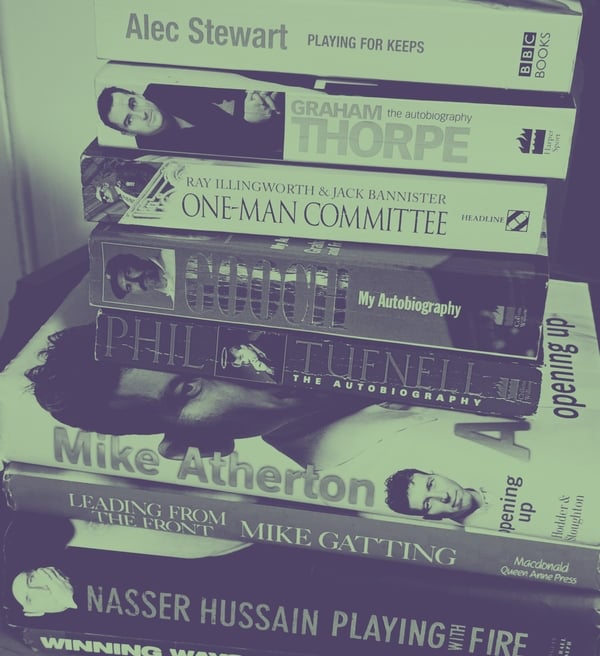
I have a friend who makes a point of noticing one of the books on my shelf each time he visits.
‘I see Mike Atherton still has pride of place,’ he chuckles. ‘Get a lot of reading out of that, do you?’
The implication is that most sporting autobiographies are usually read once: an easy gift for friends and family at Christmas time, these glossy hardbacks with an earnest picture of a former player on the front, featuring a workmanlike description of their career in roughly chronological order (and an often groan-worthy title) should be retained only for as long as it seems polite before being quietly deposited at the local charity shop.
Cricket books, though, will always have a special place in my heart.
I first started following England in 1993, watching the team lose heavily in India before succumbing meekly to the Australians during the following home summer. Unperturbed by their lack of success, my obsession with consuming as much cricket-related content as possible was frustrated by the long gaps between matches and the fact that the internet didn’t really exist yet.
A collection of old books and biographies was passed onto me shortly afterwards, following the sad death of my Great Uncle Jim. Jim had been a die-hard fan of cricket, particularly Yorkshire cricket, and titles by, and about, my home county’s greats — Boycott, Bairstow, Illingworth et al. — were heavily represented.
However, I was mainly drawn to Mike Gatting’s Leading From the Front, not only because the Middlesex captain was a southern outlier, but because it told me something about why Gatting — previously an Ashes-winning captain, but by this point making negligible contributions to a struggling England batting line-up from within the ranks — was still being selected.
It gave me an early taste of a cricketing controversy, too, in the form of his on-pitch confrontation with the Pakistani umpire Shakoor Rana in 1987/8 that led to something approaching a diplomatic crisis. It wasn’t until later that I learned that the publication of the book, as much as the incident itself, had been the beginning of the end of Gatting as England captain, and he was sacked early the following summer.
The politics of sackings, selection, and other off-field matters was also a recurring theme of the various Yorkshire tomes. After digesting various detailed accounts of the dismissal, and then reinstatement, of Geoffrey Boycott as a Yorkshire player prior to the 1984 season, my requests for further discussion rather baffled my father, who despite being my main source of cricketing information suggested that my knowledge of this (then) decade-old feud already outstripped anything he might have to offer on the subject.
Boycott towered above the other Yorkshire greats, due to the prominence of his strident punditry on TV and radio, and easily lampooned style. A copy of Boycott on Cricket, released in 1990, was my next step after Gatting, and certainly delivered on its promise of strong opinions on a variety of issues, including the poor techniques of young English batsmen and the flaws and failures of fading modern greats David Gower and Ian Botham.
If this was in keeping with the stereotypical ‘Boycs’ of TV and radio commentary, his three winter tour diaries released a decade earlier — Put to the Test, Opening Up and In the Fast Lane — revealed a slightly more measured and thoughtful side, as he battled personal demons and some formidable bowling attacks while approaching his fifth decade.
My team, though, was Atherton’s, and I eagerly bought his book as soon as it was released in 2002. First impressions offered little deviation from the unremarkable template described above: a picture of the former England captain, dressed in a plain shirt and fashioning a quarter-smile, appearing above a title that referenced his playing role at the top of the batting order while rather weakly promising that the pages within would help shed his then-taciturn reputation.(1)
Against all odds, though, it was everything I had hoped for, and more.
The same sadly cannot be said for the books of all other 90s cricketers, although I continued to acquire them anyway. While my first experiences of cricket biographies told tales of a past with which I was unfamiliar and was unable to otherwise access, my subsequent fanaticism had led me to internalise all of the ups and downs of the England team in the 90s, and I was frequently disappointed when little further insight was offered or — worse still — what I considered to be major events (2) were discussed only in passing or omitted completely.
After returning to Yorkshire following many years away, and seeking to rekindle the passion for cricket that I had all those years ago, I hatched a plan during a doomed summer watching county cricket in the cold: go back to the 90s, and revisit those players, those times, and those feelings, via my old cricket library.
Despite many of these books (3) surviving multiple house moves over the years, others had been either lost or given away, and so for the purposes of research — as I told my wife — their immediate reacquisition was crucial, as were my efforts to address any other significant historic gaps in the collection.
And so, here we are, ready to look at the major characters of English cricket in the 90s through their own published works. If you’re the kind of person who, like me, finds themselves unexpectedly thrilled by the news that a hardback copy of Winning Ways by Dermot Reeve can be theirs for less than a fiver, then I hope you’ll find something to enjoy here.
And if you are that kind of person, the name of this project will already make sense.
‘Young lions are going to roar!’ promised Sky’s promo music during that tour of India in 1993. They certainly didn’t in that series, but there were moments in the 90s — sometimes — when they did.
--
Want more? Sign up to Young Lions Sometimes Roar on Substack to receive the latest posts first.
Notes:
(1) It was also, like Boycott’s 1980 effort, called Opening Up. I guess there aren’t that many clever pun-based titles out there, after all, which is probably why many opt instead for the safer territory of ‘The Autobiography’ or ‘My Autobiography’.
(2) Note: we’re not talking about actual major events, here. But I considered anything but a detailed series-by-series breakdown as some kind of betrayal: no, don’t skip over England’s narrow 1-0 victory over India in 1996, actually – some of us want to know about Alan Mullally’s debut, whether Ronnie Irani should have been dropped for Mark Ealham, and why Min Patel only got two caps.
(3) Including, of course, Athers’ Opening Up, the recurrent appearance of which in the spare bedrooms of multiple homes over the years apparently proving noteworthy enough to attract comment.
More Profiles
© Ben Richards 2026